

An annulment in Michigan is a court judgment declaring that a marriage was never legally valid. It is available only on grounds set by statute, such as bigamy, a close family relationship, an underage spouse, lack of capacity, or force or fraud.
Unhappiness, regret, or a short marriage alone does not qualify, and a spouse without one of the specific grounds for annulment ends the marriage through divorce.
Mackensen Law, PLLC, a Birmingham, Michigan family law firm, handles annulment cases alongside its divorce and family law practice for clients in Wayne, Oakland, Macomb, and surrounding counties.
An annulment is a decree of nullity, a finding that the marriage was defective from the start rather than ended later. Under MCL 552.3, when a marriage’s validity is in doubt on a statutory ground, a spouse may petition the circuit court in the county where either spouse lives. The case then follows divorce procedure.
The difference lies in the question the court answers. A divorce asks whether the marriage has broken down. An annulment asks whether a legal marriage ever existed, so the filing spouse must prove a specific statutory defect.
Michigan Legal Help notes that Michigan has no standard court form for annulment, so each complaint is drafted to fit the grounds and the facts. A religious annulment through a church is separate and has no effect on civil marital status.
The first question is whether the facts support annulment, divorce, or both. Mackensen Law answers it in a free consultation.
Michigan’s grounds come from the Michigan Compiled Laws, Chapter 552, and they fall into two groups. Some marriages are void under the statute itself, while other provisions control who may sue for annulment and when.
MCL 552.3 lets either spouse ask the court to declare a doubtful marriage void, which gives the record a judgment to rely on.
| Ground | Statutory Status | Who May Sue and Key Limits |
| Existing marriage (bigamy) | Absolutely void under MCL 552.1 | Either spouse may petition under MCL 552.3 |
| Close family relationship | Absolutely void under MCL 552.1 | Either spouse may petition under MCL 552.3 |
| Lack of legal capacity at the wedding | Absolutely void under MCL 552.1 | A court-admitted next friend may sue under MCL 552.35; a spouse who later gains capacity may sue under MCL 552.36 unless the spouses then cohabited |
| Force or fraud in obtaining consent | Void under MCL 552.2 unless the spouses later voluntarily cohabited | MCL 552.37 bars annulment after voluntary cohabitation as spouses before the suit |
| Physical incapacity | Ground for annulment under MCL 552.39 | Only the injured spouse may sue, within 2 years of the wedding |
| Underage spouse | Governed by the law in effect on the wedding date | See the age discussion below |
The age rules depend on when the wedding happened. 2023 Public Act 71 took effect September 19, 2023. It bars anyone under 18 from marrying in Michigan and makes such a Michigan marriage void. Earlier marriages fall under the older rules, which allowed some 16- and 17-year-olds to marry with parental consent.
Under MCL 552.34, a parent, guardian, or next friend brings that older underage claim.
Fraud is the most commonly misunderstood ground. The Social Security Administration’s Michigan marriage summary, which applies Michigan case law, describes the standard:
A lie about income or past relationships rarely meets that bar on its own.
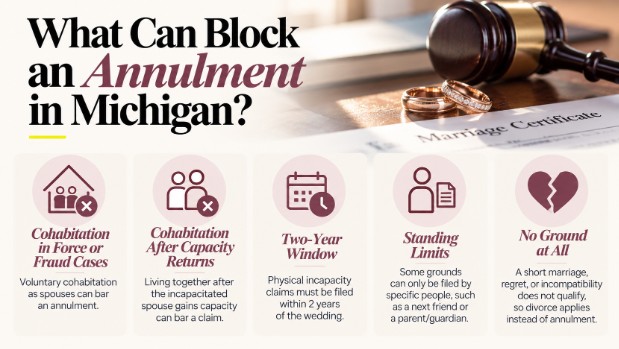
Later conduct can defeat a claim even when a ground once existed. The statutes set the bars, and courts have interpreted some of them.
A barred claim usually leaves divorce open, allowing spouses to settle terms through family mediation.
Whether continued living together defeats a particular claim turns on facts such as when the spouse learned of the defect and whether the cohabitation was voluntary.
When a bar applies, the court still divides property and sets custody and support through the divorce process instead.
Both end the legal relationship, but they rest on different legal questions and address financial issues through different statutes.
The divorce path also runs on its own clock, and Michigan divorce timelines depend on waiting periods and whether children are involved.
| Issue | Annulment | Divorce |
| Legal question | Was the marriage ever valid? | Has the marriage broken down? |
| Required proof | A specific statutory defect | A breakdown with no reasonable likelihood of preservation |
| Typical timing | Prompt filing matters, since later conduct can bar some claims | Any time, subject to waiting periods |
| Property | MCL 552.19 lets the court restore property that came to a spouse through the marriage, or its value | Division of the marital estate |
| Spousal support | MCL 552.23, the main support statute, names divorce and separate maintenance but not annulment, so availability is a case-specific legal question | Available under MCL 552.23 |
| Children | Custody, parenting time, and support orders under MCL 552.16 | Custody, parenting time, and support orders under the same statute |
The statutes define these differences but do not resolve every financial question. Some couples qualify for both remedies, and each path’s property and support consequences deserve attorney review before filing.
An annulment does not leave children without legal protection. Michigan statutes address both legitimacy and custody, and child custody decisions in an annulment still turn on each family’s facts.
Custody in an annulment draws on the same best-interest analysis as any custody case. Parents who agree on a schedule can put the terms in a written parenting plan for the court to review and enter, which avoids a contested custody hearing alongside the annulment.
An annulment consultation turns on a short list of questions, and the answers usually decide whether annulment, divorce, or both are worth pursuing.
Useful records to bring:
Arriving with those records shortens the first meeting considerably. Mackensen Law reviews them and the strongest legal path in a confidential consultation.
Wayne County annulment cases go to the Third Judicial Circuit Court, Family Division, because MCL 552.3 allows filing in the county where either spouse lives.
Oakland County residents file in the Sixth Judicial Circuit Court, Family Division, in Pontiac under the same rule. Attorney Logan Jacobson Mackensen handles annulment cases in Wayne, Oakland, Macomb, and other Michigan counties.
Mackensen Law covers every stage: weighing annulment against divorce, drafting the complaint, negotiating or litigating custody and property terms, and securing the final judgment.
How long does a spouse have to seek an annulment in Michigan?
The deadline depends on the grounds. A physical incapacity claim must be filed within 2 years of the wedding under MCL 552.39, and a force or fraud claim may be barred if the couple voluntarily cohabited as spouses before filing suit under MCL 552.37.
Can a marriage be annulled for fraud in Michigan?
Yes, under MCL 552.2 and 552.37. Michigan courts require deception that was intentional, present at the wedding, central to the marriage itself, and clearly proven. Voluntary cohabitation as spouses after the deceived spouse had proof of the fraud can bar the claim.
Is a marriage to someone under 18 valid in Michigan?
Not for Michigan marriages on or after September 19, 2023. Under 2023 Public Act 71, no one under 18 may marry, and such a marriage is void. Courts apply the age and standing rules in effect when the wedding took place.
What evidence supports an annulment claim in Michigan?
The evidence depends on the ground. A prior marriage record or divorce judgment proves bigamy, birth records prove age, and documents or messages can show fraud. A clear timeline of when the defect came to light helps answer any cohabitation defense.
Are children of an annulled marriage legitimate in Michigan?
Yes, under several provisions. MCL 552.1 declares children of a void marriage legitimate, and MCL 552.29 presumes legitimacy for children born before the case began. Under MCL 552.16, the court can enter custody, parenting time, and support orders in an annulment.
Can a spouse get alimony after an annulment in Michigan?
The answer depends on the case. MCL 552.23, the main spousal support statute, names divorce and separate maintenance but not annulment. Under MCL 552.19, the court can restore property that came to a spouse through the marriage, and an attorney can assess other relief.
Where does a spouse file for an annulment in Wayne County?
Annulment cases go to the Wayne County Third Judicial Circuit Court, Family Division, when either spouse lives in Wayne County. As of October 2026, the Wayne County Clerk lists in-person family filings at the Coleman A. Young Municipal Center, Suite 201, in Detroit.
Is a church annulment the same as a legal annulment in Michigan?
No. A religious annulment affects standing within a faith and has no effect on legal marital status. Only a Michigan circuit court judgment of nullity, or a divorce judgment, ends a marriage for legal purposes such as property, support, and remarriage.
A Michigan annulment depends on three questions:
Children of these marriages keep legal protection either way, and custody follows the court’s best-interest analysis.
Delay can close the door on some annulment claims. Mackensen Law reviews the facts, the timeline, and both paths in a free consultation.