

In Oakland County, a parenting time coordinator appointment begins with the parents’ agreement rather than a court-imposed order. MCL 722.27c requires consent from both parents and the coordinator, and requires the court to consider any history of a coercive or violent relationship first.
The statute, rather than a county form, dictates what the appointment order must contain.
Logan Jacobson Mackensen, J.D., sits on Oakland County’s approved mediator rosters and takes coordinator appointments alongside custody and parenting time representation at Mackensen Law, PLLC, a family law office in Birmingham, Michigan.
A stipulated order missing the statute’s required elements creates problems later. Mackensen Law drafts Oakland County appointment orders — book a free consultation.
It starts with agreement rather than a filing. Under subsection (2) of MCL 722.27c, an Oakland County judge may appoint a coordinator only where the parties and the coordinator agree to the appointment and its scope.
The same subsection carries a second requirement that matters as much as consent. Before appointing, the court must consider whether either parent has a history of a coercive or violent relationship, and the appointment order must provide adequate protection to a victim.
That duty continues after entry: subsection (7) requires the coordinator to make reasonable inquiry into such a history using the State Court Administrative Office’s domestic violence screening protocol, and subsection (8) directs that the coordinator may not bring the parents into proximity with each other unless the parent at risk requests it and reasonable safeguards exist.
Coordination is therefore not universally suitable. A process built on direct communication between parents, with a neutral who may speak to either side separately and whose communications are largely unprotected, asks participants to do something that is not appropriate in every case.
Where coercion or violence is present, the statute contemplates the court weighing suitability before entry and retaining the power under subsection (4) to terminate the appointment where the process is no longer safe.
That sequencing is unusual in family law, where most relief arrives by motion, and most disagreements resolve by ruling. Here the court reviews and enters what the parents have negotiated, including who the coordinator will be.
Because the Oakland County Circuit Court Family Division handles custody and parenting time inside the broader case, the appointment order typically enters the same file as the judgment. The statutory framework behind the role appears in parenting time coordination.
A stipulated order is the vehicle that can actually produce an appointment, because the statute conditions appointment on agreement. Both parents sign, the proposed coordinator has agreed to serve, and the order goes to the judge for entry.
A motion does something narrower than parents expect. One parent can file to put the question before the court, but a motion cannot produce an appointment over the other parent’s objection.
The consent requirement in subsection (2) is statutory rather than discretionary, which means a judge who thinks coordination would help a family still cannot order it where one parent declines.
The consequence is worth stating plainly: a parent facing genuine refusal does not have a procedural problem to solve.
They have a dispute that belongs in a motion seeking relief the court can grant on its own authority, such as enforcement or modification, rather than one seeking a neutral the other parent must agree to.
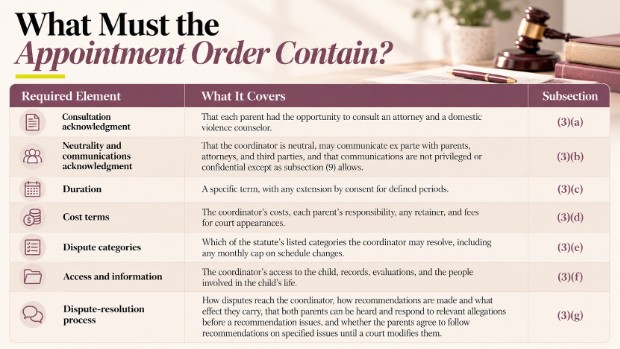
Subsection (3) sets out what the order has to address. Oakland County parents drafting a stipulated order work from this list rather than a county template.
| Required Element | What It Covers | Subsection |
| Consultation acknowledgment | That each parent had the opportunity to consult an attorney and a domestic violence counselor | (3)(a) |
| Neutrality and communications acknowledgment | That the coordinator is neutral, may communicate ex parte with parents, attorneys, and third parties, and that communications are not privileged or confidential except as subsection (9) allows | (3)(b) |
| Duration | A specific term, with any extension by consent for defined periods | (3)(c) |
| Cost terms | The coordinator’s costs, each parent’s responsibility, any retainer, and fees for court appearances | (3)(d) |
| Dispute categories | Which of the statute’s listed categories the coordinator may resolve, including any monthly cap on schedule changes | (3)(e) |
| Access and information | The coordinator’s access to the child, records, evaluations, and the people involved in the child’s life | (3)(f) |
| Dispute-resolution process | How disputes reach the coordinator, how recommendations are made and what effect they carry, that both parents can be heard and respond to relevant allegations before a recommendation issues, and whether the parents agree to follow recommendations on specified issues until a court modifies them | (3)(g) |
Subsection (3)(g) is broader than the question of whether recommendations bind. It also includes the opportunity for each parent to respond before a recommendation is made, which is the closest thing the arrangement has to a due-process protection.
The acknowledgment at subsection (3)(b) is the one parents read fastest.
Agreeing to the order means agreeing that communications with the coordinator are not privileged or confidential, subject to the safety exception at subsection (9), and that the coordinator may speak with the other parent or their attorney without the first parent present.
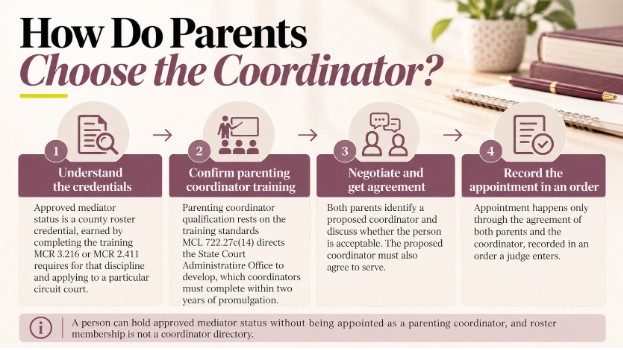
Selection is negotiated, since the proposed coordinator must also agree to serve. Three separate things get conflated here and are worth separating:
A person can hold the first without the third, and roster membership is not a coordinator directory.
The rosters are still useful to parents, because the people on them have completed a recognized training track and have been vetted by the same court that will enter the appointment order.
Oakland County publishes an approved domestic mediators list and a separate approved civil mediator list, both maintained through the court’s alternative dispute resolution clerk, and the domestic list encourages parties to select their own mediator for mediation referrals.
Both rosters publish an hourly rate beside each name. Parenting coordination is a separate role with its own rate, set in the appointment order rather than on the roster, though parents comparing candidates at least begin with a visible benchmark for what neutrals in this county charge for mediation.
Those weighing a coordinator against another route can compare the options against divorce and family mediation before committing to either.
Entirely by what the order says. Subsection (3)(d) requires the appointment order to fix the financial terms in writing before any work begins.
| Fee Question | How Michigan Handles It | Authority |
| Who pays, and in what share | Stated in the appointment order for each parent | MCL 722.27c(3)(d) |
| Retainer | Amount and responsibility stated in the order | (3)(d) |
| Fees for court appearances | Stated in the order rather than billed ad hoc | (3)(d) |
| Costs one parent generated | The order may permit the coordinator to allocate specific costs to that parent for cause | (3)(d) |
| A parent who stops paying | The coordinator may resign with notice; the court may hold a parent in contempt for refusing payment as a means to force a resignation | (5) |
The allocation-for-cause provision is optional, which makes it a drafting decision rather than a default.
An order that splits costs evenly and says nothing further leaves the coordinator no mechanism to shift expense toward the parent who generated a particular dispute. Including the provision preserves that option; omitting it forecloses it for the life of the appointment.
Nonpayment protections run both ways. The coordinator is not required to keep working unpaid, and a parent who withholds fees specifically to force the coordinator out faces contempt.
Parents managing this alongside an active divorce should treat the fee terms with the same care as the property settlement.
The coordinator begins work inside the scope the order defines, taking the listed categories of dispute and issuing recommendations. Subsection (10) requires those recommendations in writing, delivered to the parents in the manner the order specifies.
Their evidentiary status surprises people. A parent may attach a recommendation to a motion or other filing, and the court may read and consider it — but the recommendation is not evidence unless both parents stipulate that it is.
Attaching one therefore puts it in front of the judge without proving anything, and the motion still has to stand on its own facts.
Whether a recommendation binds the parents in the meantime depends on what they agreed under subsection (3)(g).
Nothing about the arrangement is permanent. The term expires on the date the order states unless both parents consent to an extension. The coordinator may resign at any time with notice to the parties and the court.
A judge may terminate the appointment where it is no longer helpful or where the process is no longer safe for a parent or a child.
Parents sometimes confuse the coordinator with the Oakland County Friend of the Court, a court office at 230 Elizabeth Lake Road in Pontiac handling support, custody and parenting time enforcement.
A coordinator is a private neutral the parents choose and pay. The two can operate in the same case without overlapping, and a dispute that belongs with the Friend of the Court does not become a coordination matter because a coordinator is already appointed. What the role covers appears under coordination services.
Does Oakland County have a form for appointing a parenting coordinator?
The appointment order is drafted from the requirements in MCL 722.27c rather than completed on a county template. Parties submitting a stipulated order should confirm current filing practice with the Oakland County Circuit Court’s alternative dispute resolution clerk before filing.
Can one parent force the appointment of a parenting coordinator?
No. MCL 722.27c requires that both parents and the coordinator agree to the appointment and its scope. A motion can put the question before the judge, but no order can compel an unwilling parent to accept a coordinator in the case.
What protections apply when there is a history of domestic violence?
Michigan requires the court to consider any history of a coercive or violent relationship before appointing and to provide adequate protection in the order. The coordinator screens using the state protocol and must not bring the parents into proximity unless requested.
How do parents choose a parenting coordinator in Oakland County?
Parents and the proposed coordinator must agree, so selection is negotiated rather than assigned. Oakland County publishes approved mediator rosters through its alternative dispute resolution clerk, which gives parents a court-vetted place to start their search.
Who pays for a parenting coordinator in Oakland County?
The parents do, as the appointment order states. MCL 722.27c requires the order to set out the coordinator’s costs, each parent’s responsibility, any retainer, and fees for court appearances, all fixed in writing before the coordinator begins work.
Can a parenting coordinator charge one parent more than the other?
The appointment order may allow the coordinator to allocate specific costs to one parent for cause. That provision protects the arrangement when one parent creates disputes that the other should not have to fund equally.
How long does an Oakland County parenting coordinator appointment last?
As long as the appointment order specifies. MCL 722.27c requires a stated duration, and any extension runs by the parties’ consent for defined periods, so the arrangement ends unless both parents actively agree to continue it past the stated term.
Are a parenting coordinator’s recommendations evidence in court?
Not unless both parents stipulate. MCL 722.27c requires recommendations in writing, and a parent may attach one to a motion. The court may read and consider it, but the recommendation does not become evidence on its own in the proceeding.
Is a parenting coordinator the same as the Friend of the Court?
No. The Oakland County Friend of the Court is a court office handling support, custody, and parenting time enforcement. A parenting coordinator is a private neutral the parents select and pay, appointed by agreement for a defined term of service.
Can the appointment be ended early?
Yes. A court may terminate it if the arrangement is no longer helpful or safe for a parent or a child. The coordinator may also resign at any time with notice to the parties and the court handling the case.
Appointment in Oakland County is a negotiated event rather than a contested one. Both parents and the coordinator must agree, the court must weigh any history of coercion or violence before entering the order, and the statute provides the seven elements the order must address.
Fee allocation, the monthly cap on schedule changes, the process for being heard before a recommendation issues, and whether recommendations bind are all settled before the judge signs.
Oakland County parents do not have to negotiate an appointment order alone. Mackensen Law reviews scope, fees and duration before anyone signs — get in touch.