

A parenting time coordinator in Michigan decides what the appointment order authorizes. MCL 722.27c confers no standing decision-making power — authority comes from the parents’ written consent to a defined scope, and recommendations are advisory unless the parents agreed in advance to follow them.
Custody, child support, and relocation ordinarily stay with the court.
Mackensen Law, PLLC, a family law practice in Birmingham, Michigan, takes these appointments through attorney Logan Jacobson Mackensen, J.D., who also negotiates scope language when drafting parenting plans.
Confusion over a coordinator’s authority costs parents motions they did not need. Mackensen Law clarifies scope before an appointment during a free consultation.
The appointment order defines a parenting coordinator’s authority. Under subsection (2) of MCL 722.27c, a court may appoint a coordinator only where the parties and the coordinator agree to the appointment and its scope. Scope is negotiated rather than conferred.
This runs against how most parents picture the role. The statute supplies a menu of dispute categories at subsection (3)(e) — transportation, holiday schedules, daily routines, activities, discipline, health care management, school issues, limited schedule alterations, phasing in orders, third-party participation, and child care — from which the appointment order selects.
Two coordinators in two Michigan cases can hold meaningfully different authority because the orders differ.
That makes the appointment order, rather than the statute, the document that determines what a coordinator can do in a given case — an observation about how the framework operates in practice, not a rule the statute states.
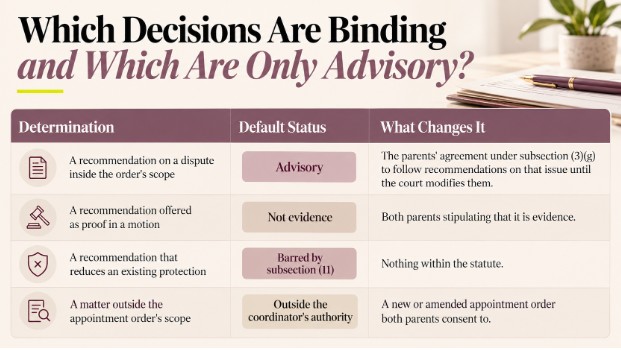
Advisory is the default. Subsection (10) requires written recommendations, delivered as the appointment order specifies, and a recommendation is not evidence unless the parties stipulate that it is.
Binding force arises through the parents’ own agreement under subsection (3)(g), which allows them to agree that on specified issues they will follow recommendations until a court modifies them.
| Determination | Default Status | What Changes It |
| A recommendation on a dispute inside the order’s scope | Advisory | The parents’ agreement under subsection (3)(g) to follow recommendations on that issue until the court modifies them |
| A recommendation offered as proof in a motion | Not evidence | Both parents stipulating that it is evidence |
| A recommendation that reduces an existing protection | Barred by subsection (11) | Nothing within the statute |
| A matter outside the appointment order’s scope | Outside the coordinator’s authority | A new or amended appointment order both parents consent to |
Parents choosing coordination make two decisions at once: whether to appoint a coordinator, and which categories of recommendations they will treat as controlling in the interim.
Those can be answered differently. A parent may agree that exchange logistics recommendations bind while reserving schedule questions for the court.
Schedule authority exists but is numerically capped. Subsection (3)(e) permits the appointment order to authorize alterations to the parenting schedule within a stated number of days per month. The cap is written into the order rather than fixed by statute, so it varies case to case.
The design makes sense in practice. A parent who needs to swap a Tuesday for a Thursday because of a work shift has a route that avoids a motion. A parent who wants the summer schedule restructured does not. The cap marks the line between administering an order and rewriting it.
Phasing in a court order is treated separately. Where a judgment contemplates a step-up schedule — parenting time expanding as a child ages or as a parent completes a treatment requirement — the appointment order can give the coordinator a role in sequencing those transitions.
Parents handed a recommendation they disagree with have options beyond compliance. Mackensen Law reviews the next step at no cost — request a case review.
Several categories fall outside what an appointment order can give a coordinator, because other statutes assign those decisions to a court. Worth stating precisely: MCL 722.27c does not itself prohibit a coordinator from touching custody or support. The limit arises from the scope requirement in subsection (2) read alongside the law governing each decision.
| Decision | Ordinarily Decided By | Authority |
| Changing legal or physical custody | The court | MCL 722.27(1)(c), applying MCL 722.23 |
| Moving a child’s legal residence more than 100 miles, where MCL 722.31 applies | The court, absent the other parent’s consent | MCL 722.31 |
| Setting or changing child support | The court | Michigan Child Support Formula |
| Schedule changes beyond the order’s monthly cap | The court | MCL 722.27c(3)(e) |
Custody carries the heaviest burden. Modification requires proper cause or a change of circumstances, and where an established custodial environment exists, the moving parent must show by clear and convincing evidence that the change serves the child’s best interests.
Relocation is more qualified than the shorthand suggests. The 100-mile restriction does not apply where the order grants one parent sole legal custody, where the two residences were already more than 100 miles apart when the custody order took effect, or where the move brings the residences closer together.
Parents may also agree in writing on how residence changes will be handled, and a parent fleeing domestic violence may relocate immediately pending the court’s determination.
Where the restriction does apply, the court weighs whether the move improves the quality of life for the child and parent, whether either parent is maneuvering over parenting time, whether a modified schedule can preserve the other relationship, whether the objecting parent seeks a financial advantage, and any history of domestic violence.
A parent facing any of these is in litigation rather than administration, and is better served talking to counsel about custody disputes than to a coordinator.
MCL 722.27c sets out no objection procedure or deadline of its own. The statute leaves disagreement to ordinary motion practice, though an appointment order or a particular court’s local practice may add steps of its own.
A parent who disagrees files a motion with the court. Subsection (10) allows that parent to attach the recommendation and provides that the court may read and consider it, while the recommendation is not evidence unless both parents stipulate.
Attaching a recommendation therefore puts it in front of the judge without proving anything, and the motion still has to stand on its own facts.
Where the parents agreed to follow recommendations on an issue, the recommendation governs conduct until the court says otherwise, so a parent who stops complying risks an enforcement motion.
Where no such agreement exists, the recommendation carries no independent force, and either parent can take the underlying dispute to the judge directly.
Coordinator testimony is a separate question. Under subsection (12), a court may allow it where it finds the testimony useful, though the coordinator may not testify about a child’s statements when disclosure would damage the child.
Parents who assumed their conversations with the coordinator were protected may learn otherwise at an inconvenient moment, which is why the non-confidentiality acknowledgment deserves attention when the order is signed rather than later.
Those weighing coordination alongside other routes can compare it against mediation before committing.
The statute sets the outer boundary of what an appointment order may cover, and several of its provisions are things the order is required or permitted to address:
Certain provisions operate regardless of what the order says. Subsection (11) prohibits a coordinator from recommending relief less protective than any other order related to the parties.
Subsection (13) requires reporting suspected child abuse or neglect to state authorities. A coordinator may resign at any time with notice, a court may terminate the appointment where it is no longer helpful or no longer safe, and subsection (9) permits a coordinator to withhold information where disclosure would compromise the safety of a parent or a child.
Which of these items a particular family should negotiate for is a separate question from what the statute permits, and one worth putting to counsel before signing.
Parents handling this alongside an active divorce are often signing the appointment order at the same time as the judgment, with less attention paid to the one that governs daily life.
Can a parenting time coordinator make binding decisions in Michigan?
Only where the parents agreed in the appointment order to follow recommendations on specified issues until a court modifies them. Absent that agreement, a recommendation is advisory and is not evidence unless both parents stipulate to it in the case.
Can a parenting coordinator change custody in Michigan?
No. Custody modification requires proper cause or a change of circumstances under MCL 722.27, and changing an established custodial environment requires clear and convincing evidence. Those determinations belong to the court, not to a coordinator appointed by the parties’ consent.
Can a parenting coordinator decide child support?
No. Michigan child support is calculated under the Michigan Child Support Formula and entered by the court. A parenting coordinator resolves disputes about implementing parenting time, not about the amount either parent pays, and support disputes return to the court.
Can a parenting coordinator approve a move out of state?
No. Where MCL 722.31 applies, moving a child’s legal residence more than 100 miles requires the other parent’s consent or court permission. The statute includes exceptions, and the court weighs listed factors, but a coordinator decides either way.
How much can a parenting coordinator change the parenting time schedule?
Only within the monthly limits the appointment order specifies. The statute allows the order to authorize schedule alterations up to a stated number of days per month, and anything larger requires a motion filed with the court instead of a recommendation.
How does a parent object to a parenting coordinator’s recommendation?
MCL 722.27c sets out no objection procedure or deadline. A parent who disagrees files a motion with the court. The recommendation may be attached, and the court may read and consider it without treating it as evidence.
Can a parenting coordinator recommend something that reduces a protective order?
No. The statute bars a coordinator from recommending relief that is less protective than any other order related to the parties. Existing protections set a floor that a recommendation cannot lower, whatever the parents have agreed to in the appointment order.
What happens if a parent simply ignores a recommendation?
Where the parents agreed to follow recommendations on that issue, the other parent may seek enforcement or modification through the court. Where no such agreement exists, the recommendation carries no independent force and the dispute returns to the judge for decision.
Can a parenting coordinator testify in court?
A Michigan court may allow a coordinator’s testimony where it finds the testimony useful. The coordinator may not testify about a child’s statements when disclosure would damage the child, and must report suspected child abuse or neglect to state authorities.
A parenting coordinator’s authority is a negotiated quantity, written into the appointment order and bounded by the parents’ consent. Recommendations are advisory unless the parents made them otherwise.
Custody, support, relocation under MCL 722.31, and schedule changes past the order’s monthly cap are assigned elsewhere by law. MCL 722.27c provides no objection procedure of its own, so disagreement runs through ordinary motion practice.
Parents who negotiate the appointment order carefully spend less time arguing later about what the coordinator was allowed to do.
Recurring disputes over who decides what rarely resolve themselves. Mackensen Law helps Michigan parents set or revisit coordination terms — start the conversation.