

Parenting time coordination is a court-ordered process in which a neutral third party helps separated parents carry out an existing parenting time order and settle the disputes that arise under it.
Michigan authorizes the role at MCL 722.27c, which permits appointment only where both parents and the coordinator agree. A parenting coordinator issues written recommendations, not orders.
Logan Jacobson Mackensen, J.D., a Birmingham, Michigan family law attorney and certified mediator, accepts these appointments and drafts parenting plans with the role’s limits in view.
Repeat motions over exchange times drain a family’s resources. Mackensen Law reviews whether coordination fits a case during a free consultation.
A parenting coordinator is a court-appointed neutral who helps parents implement the parenting time orders already entered in their case and resolve disputes that arise under those orders.
The role exists by statute at MCL 722.27c, added by 2014 Public Act 526 and effective January 14, 2015.
The function sits downstream of the decisions a judge has already made. The court sets custody and the parenting time schedule.
The coordinator operates inside that framework, taking the friction the order generates in daily life and working it through without a motion, a hearing date, and two sets of attorney fees.
Michigan built in a safeguard at the front end. A court may not impose a coordinator on an unwilling parent, which means the process starts from agreement even when nothing else in the case does.
Appointment requires consent and a written order that defines the arrangement. Under subsection (2), the court may appoint a coordinator only where the parties and the coordinator all agree to the appointment and its scope, and the court must consider any history of a coercive or violent relationship before doing so.
The appointment order itself must address:
A court may terminate the appointment where it is no longer helpful or where the process is no longer safe for a parent or a child, under subsection (4). The coordinator may resign at any time with notice to the parties and the court.
Subsection (3)(e) lists the categories a coordinator may be authorized to handle. The appointment order controls which of them apply in a given case, so scope is set case by case rather than by the statute alone.
| Dispute Category | What It Covers |
| Transportation and transfers | Pickup and drop-off arrangements and exchange logistics |
| Vacation and holiday schedules | Allocation of holidays, school breaks, and travel |
| Daily routines | Bedtimes, homework, and household rules across two homes |
| Activities and recreation | Sports, lessons, and extracurricular enrollment |
| Discipline | Consistency of approach between households |
| Health care management | Medical, mental health, substance abuse, and batterer intervention treatment |
| School issues | Enrollment, conferences, and academic decisions |
| Parenting schedule alterations | Changes within the monthly limits the appointment order specifies |
| Phasing in court orders | Step-up schedules and transitions between arrangements |
| Participation of other persons | Who else may be present during parenting time |
| Child care | Babysitting and day care arrangements |
To work through these, subsection (3)(f) permits the coordinator reasonable access to the child, notice of proceedings affecting the child, school and medical records, therapists’ records with a proper release, friend-of-the-court reports, and interviews with the parents, their attorneys, the child, and the child’s teachers and principal.
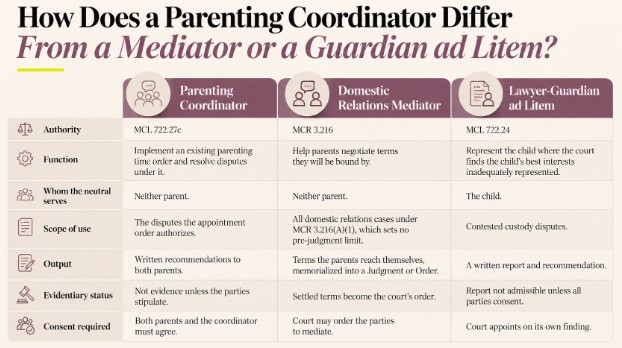
Three neutrals appear in Michigan custody matters, and they do different jobs. The difference is functional rather than chronological, which is where most misunderstandings about custody disputes begin.
| Parenting Coordinator | Domestic Relations Mediator | Lawyer-Guardian ad Litem | |
| Authority | MCL 722.27c | MCR 3.216 | MCL 722.24 |
| Function | Implement an existing parenting time order and resolve disputes under it | Help parents negotiate terms they will be bound by | Represent the child where the court finds the child’s best interests inadequately represented |
| Whom the neutral serves | Neither parent | Neither parent | The child |
| Scope of use | The disputes the appointment order authorizes | All domestic relations cases under MCR 3.216(A)(1), which sets no pre-judgment limit | Contested custody disputes |
| Output | Written recommendations to both parents | Terms the parents reach themselves, memorialized into a Judgment or Order | A written report and recommendation |
| Evidentiary status | Not evidence unless the parties stipulate | Settled terms become the court’s order | Report not admissible unless all parties consent |
| Consent required | Both parents and the coordinator must agree | Court may order the parties to mediate | Court appoints on its own finding |
A mediator helps parents reach terms—whether those terms resolve an original dispute or modify an existing order. The civil benchbook records the rule’s reach as all domestic relations cases, so mediation is not confined to any one stage.
A coordinator does something different: rather than renegotiating terms, the coordinator administers the ones that exist. A lawyer-guardian ad litem does neither and represents the child.
Parents unsure whether a coordinator or a mediator fits their situation can review both with Mackensen Law at no cost — schedule a consultation.
Not by default. Subsection (10) requires the coordinator to make recommendations in writing and provide copies to both parents, and a recommendation is not evidence unless the parties stipulate it.
Binding effect comes from agreement, not from the role. Under subsection (3)(g), parents may agree that on specified issues they will follow the coordinator’s recommendations until a court modifies them.
The appointment order records that agreement, so parents weighing coordination during a divorce are deciding two separate questions: whether to appoint a coordinator at all, and which recommendations they will treat as controlling in the meantime.
Parents most often misread confidentiality. The appointment order itself acknowledges that the coordinator may speak with either parent, either attorney, or third parties outside the other parent’s presence, and that communications are not privileged or confidential.
Subsection (9) carves out one exception: the coordinator need not disclose information where disclosure would compromise the safety of a parent or a child.
Under subsection (12), the coordinator may testify when the court finds the testimony useful, but not about a child’s statements when disclosure would harm the child.
The coordinator also cannot weaken existing protections. A recommendation may not provide less protection than the orders already in place.
Parents bear the cost. The legislative analysis of the 2014 bill confirmed the arrangement shifts coordination expense to the parties rather than the court system, with no fiscal impact on local government.
Because subsection (3)(d) requires the order to set out costs, each parent’s responsibility, any retainer, and fees for court appearances, the financial terms are fixed in writing before the work starts rather than negotiated later.
The order may also permit the coordinator to allocate specific costs to one parent for cause, which gives the arrangement some protection against a parent who generates disputes strategically.
Nonpayment carries consequences in both directions. A coordinator may resign at any time, including over unpaid fees. A court may impose contempt sanctions on a parent who refuses to pay as a means to force the coordinator to resign.
Duration is defined rather than open-ended. The order states a specific term, and any extension runs by the parties’ consent for specific periods. Parents who want out at the end of a term simply decline to extend.
Safety is the threshold question. Michigan requires the court to consider any history of a coercive or violent relationship before appointing, and the order must provide adequate protection to a victim.
Subsection (7) requires the coordinator to make reasonable inquiry into whether either parent has such a history, using the State Court Administrative Office’s domestic violence screening protocol, and subsection (8) directs that the coordinator may not bring the parents into proximity with each other unless the parent at risk requests it and reasonable safeguards are in place.
A court may end the appointment at any point where the process is no longer safe.
Beyond safety, the statute’s own structure marks out where coordination does not reach:
Coordinators also carry mandatory reporting duties for suspected child abuse, and subsection (14) directs the State Court Administrative Office to develop qualification and training standards covering violent and coercive relationships, which coordinators must complete within two years of promulgation.
Can a Michigan court appoint a parenting coordinator without both parents agreeing?
No. MCL 722.27c permits appointment only where both parties and the coordinator agree to the appointment and its scope. A parent who objects cannot be assigned a coordinator, which makes the process voluntary at the outset even after a court order exists.
Are a parenting coordinator’s recommendations binding in Michigan?
Not automatically. Recommendations are made in writing and are not evidence unless both parties stipulate. Parents may agree in the appointment order to follow recommendations on specified issues until a court modifies them, which is a separate decision.
How long does a parenting coordinator appointment last?
The appointment order must state a specific duration. Michigan law allows the order to include a provision extending the appointment for specific periods by the parties’ consent, and a court may end it earlier when the process stops helping.
Who pays for a parenting coordinator?
The parents do. The appointment order must set out the coordinator’s costs, each parent’s responsibility for them, any retainer, and fees for court appearances. The order may also allow the coordinator to allocate specific costs to one parent for cause.
Is a parenting coordinator the same as a guardian ad litem?
No. A lawyer-guardian ad litem appointed under MCL 722.24 represents the child when a court finds the child’s best interests inadequately represented. A parenting coordinator represents neither parent nor the child and implements an existing order instead of advocating for anyone.
Can a parenting coordinator change custody in Michigan?
No. Custody determinations remain with the court under the best-interest factors at MCL 722.23. A coordinator may address alterations to the parenting schedule only within the monthly limits the appointment order specifies, and larger changes return to the judge for decision.
Are conversations with a parenting coordinator confidential?
No. The appointment order acknowledges that communications with a parenting coordinator are not privileged or confidential. The one exception is safety: a coordinator need not disclose information where disclosure would compromise the safety of a parent or a child involved in the case.
How does domestic violence affect a parenting coordinator appointment?
Michigan courts must consider any history of a coercive or violent relationship before appointing, and the order must protect the party at risk. The coordinator screens using the state protocol and may not bring the parents into proximity unless the at-risk parent requests it.
What happens when one parent refuses to pay the coordinator?
A parenting coordinator may resign at any time with notice to the parties and the court. A Michigan court may impose contempt sanctions on a parent who refuses to pay to force the coordinator to resign.
Parenting time coordination occupies a narrow space in Michigan family law. It operates within an existing order, requires both parents to agree, and produces recommendations rather than rulings.
The appointment order controls everything that matters — scope, duration, cost allocation, confidentiality acknowledgments, and which recommendations the parents will treat as controlling.
Parents locked in recurring disputes over logistics rather than over custody itself are the population the statute was written for.
Recurring parenting disputes compound with every motion filed. Mackensen Law helps Michigan parents weigh coordination against litigation — start a confidential conversation.